





Millions of solar installations now power UK homes and the grid, according to the latest government deployment data, with installation volumes hitting a rate not seen for more than a decade.
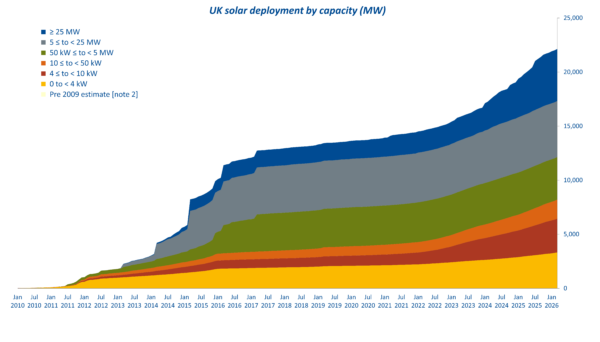
Total solar capacity reached 22.1 GW at the end of March 2026, according to provisional data from the Department of Energy Security and Net Zero (DESNZ), and while large-scale projects count for the lion’s share of generating capacity, growth in rooftop demand pushed the total number of installations to 2,003,000.
There were 27,607 installations recorded during March 2026 accounting for 121 MW of capacity: the most installations recorded in any calendar month since 2012. Total deployed capacity of 2.3 GW was added since March 2025, representing growth of 11.7% for UK solar over the 12-month period.
Roughly 16% of the solar capacity added in the 12-months to the end of March came from one site: The 373 MW Cleve Hill plant commissioned in July 2025 – the largest UK solar plant to date.
Source: UK Department for Energy Security & Net Zero (DESNZ)
That share is on course to grow significantly, with the UK government targeting at least 45 GW solar capacity by 2030. The latest CfD auction round which closed in February 2026 secured a record 4.9 GW of solar capacity across 157 plants.
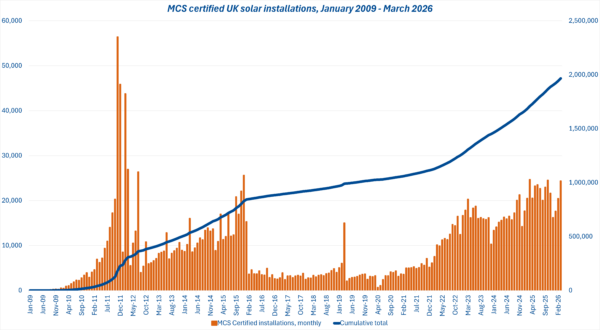
Solar arrays with capacity below 50 kW are also increasingly backed by the subsidy support. Arrays of this size accounted for 99% of the total number of installations at the end of March 2026, and 37% of total deployed capacity. Demand for this segment has taken a positive turn since early 2024.
Source: MCS Data Dashboard
The latest data from certification body MCS reveals small-scale installations have returned to volumes not seen since the feed-in tariff closed for applications. Residential installations accounted for 66% of the total in volume terms in March 2026, adding a total of 85 MW.
MCS certification is not mandatory for UK rooftop solar installations, but it does give households access to the Smart Export Guarantee – which ensures consumers are paid for exporting surplus electricity to the grid.
Higher monthly installation rates for residential solar are anticipated. The UK government has committed to spending GBP 15 billion ($20 billion) on a home energy efficiency investment program, which includes grants and loans to support millions of new rooftop installations by 2030.
The grant support will be available for new solar, battery energy storage, heat pump installations and other energy efficiency technologies. The UK government also recently committed to legalizing plug-in “balcony solar” devices in time for summer 2026.
This content is protected by copyright and may not be reused. If you want to cooperate with us and would like to reuse some of our content, please contact: editors@pv-magazine.com.

By submitting this form you agree to pv magazine using your data for the purposes of publishing your comment.
Your personal data will only be disclosed or otherwise transmitted to third parties for the purposes of spam filtering or if this is necessary for technical maintenance of the website. Any other transfer to third parties will not take place unless this is justified on the basis of applicable data protection regulations or if pv magazine is legally obliged to do so.
You may revoke this consent at any time with effect for the future, in which case your personal data will be deleted immediately. Otherwise, your data will be deleted if pv magazine has processed your request or the purpose of data storage is fulfilled.
Further information on data privacy can be found in our Data Protection Policy.