
U.S.-Israeli conflict with Iran tests solar supply
The U.S.-Israeli conflict with Iran is unlikely to materially affect solar manufacturing projects in the Middle East for now, as most of these investments remain at an early stage. OPIS analyst Brian Ng sees the most immediate risk in logistics. If disruptions persist, shipments of solar products into the region could be delayed and export pricing may turn volatile.

Chinese module trading slows after export tax rebate cancellation
In a new weekly update for pv magazine, OPIS, a Dow Jones company, provides a quick look at the main price trends in the global PV industry.
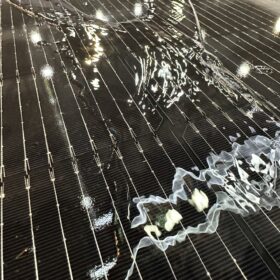
Internet-of-Things could bring solar module water cooling closer to commercial viability
A Czech team developed an IoT system using MQTT to autonomously cool PV panels, boosting daily energy yield by 7.38% with a positive net energy balance.
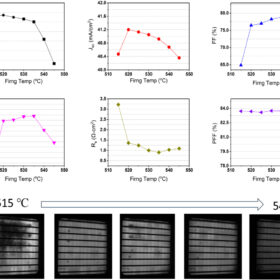
U.S. scientists build copper-contacted TOPCon solar cell with 24.3% efficiency
The TOPCon solar cells with fabricated with screen-printed, fire-through copper rear contacts and silver front contacts, using laser-enhanced contact optimization (LECO) to significantly reduce contact resistivity. Optimized copper cells achieved 24.3% efficiency, comparable to Ag-contacted cells, with excellent stability.

New tech reduces silver use in TOPCon solar cells by a factor of 10
Researchers at the Fraunhofer Institute for Solar Energy Systems ISE have reduced silver consumption in solar cell metallization to 1.1 mg/Wp using an electrodeposition-based process, down from current levels of 10–12 mg/Wp.

How to delaminate end-of-life solar modules with ultrasonic cavitation
A research team has developed a solvent-free method using ultrasonic cavitation to delaminate end-of-life crystalline-silicon PV modules, fully separating the glass and front EVA layer while partially releasing c-Si fragments. The proposed approach achieved an 82.2% mass-based delamination efficiency, highlighting ultrasonic cavitation as a sustainable alternative for PV module recycling.
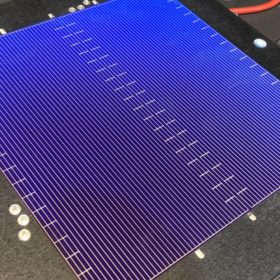
How LECO process could push TOPCon solar cell efficiency beyond 26%
A new UNSW study shows that laser-enhanced contact optimization (LECO) can boost industrial TOPCon solar cell efficiency by improving contact properties and reducing recombination losses. By combining optimized firing conditions with LECO “repair” of contacts, the approach balances recombination and resistance, offering a practical path for conventional TOPCon cells to compete with PV technologies offering higher efficiencies.

UK opens door to plug-in solar boom
In its first monthly column for pv magazine, experts from UK-based consultancy Ricardo, part of the WSP Group, explain how UK will soon allow low-cost plug-in solar panels under 800 W to be installed without a qualified electrician, making home solar more affordable and accessible. These portable systems, expected on sale by summer 2026, could significantly boost household solar adoption while complementing the country’s wider renewable energy growth.
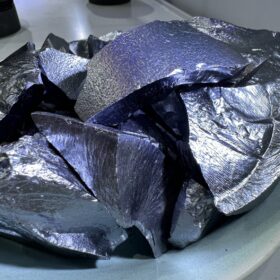
Polysilicon prices sliding toward historical lows
Polysilicon prices have fallen sharply over recent weeks due to persistent oversupply and weakening demand, briefly dipping to low levels before stabilizing slightly above CNY 50 ($7.31)/kg, though still near historical lows and below production costs. OPIS analyst Summer Zhang tells pv magazine that despite policy signals and potential future regulations, unclear implementation and continued excess capacity mean market conditions remain weak, with further demand declines and possible production cuts or discounted sales expected in the near term.
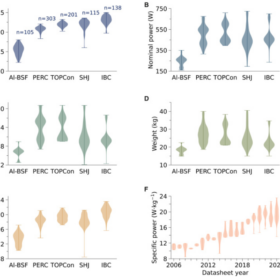
Solar keeps slimming down while power rises
An international study found that the specific power of commercial silicon solar modules increased from 8.5 W/kg in the early 2000s to 23.6 W/kg today, driven by advances in module design, bifaciality, and temperature management. The researchers highlighted that glass and framing dominate module weight, and considering operating conditions like nominal operating cell temperature and rear-side illumination is essential for accurate PV system design.
