Europe added 41.4 GW of new solar in 2022

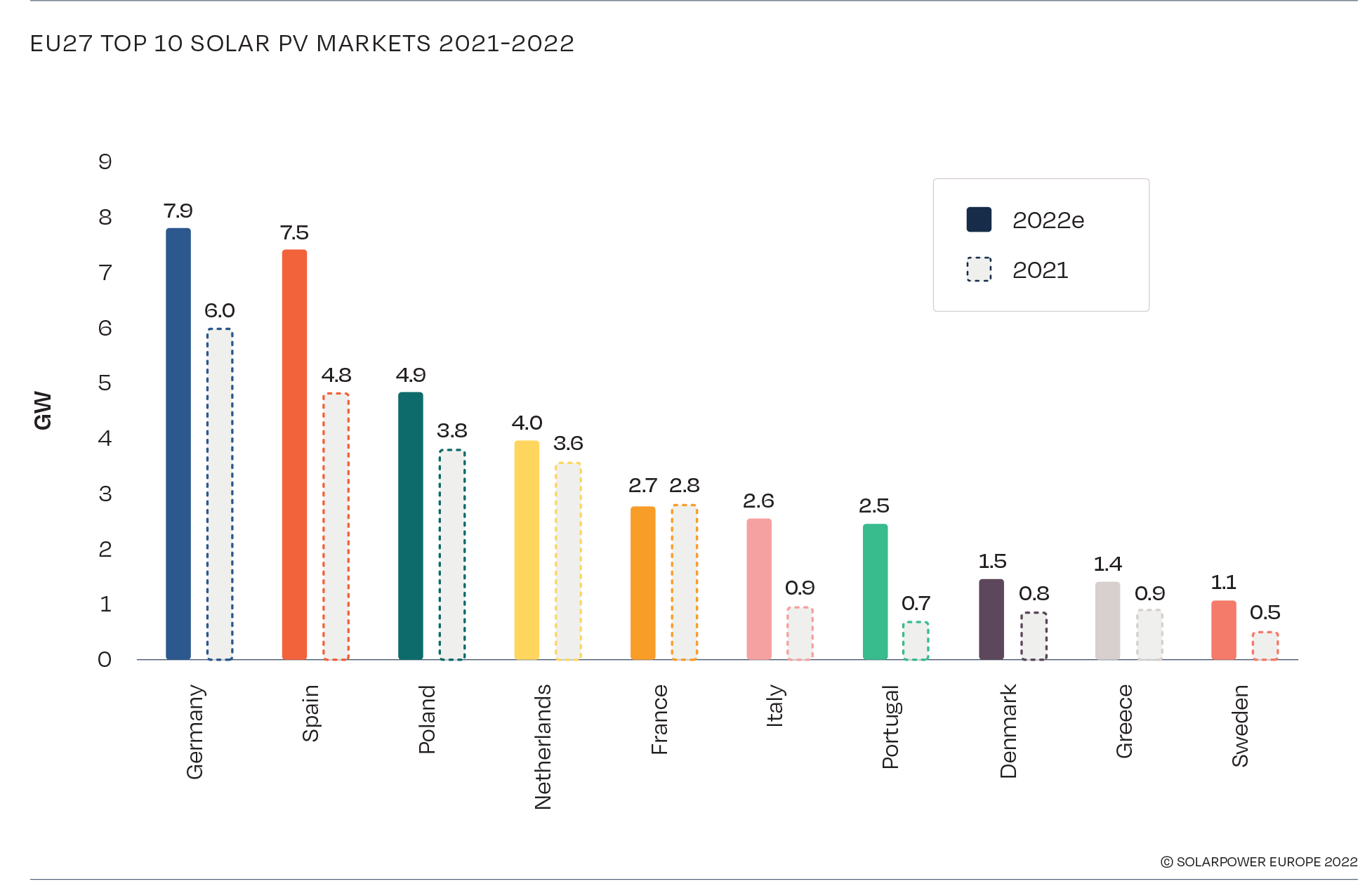
Europe added 41.4 GW of new solar capacity in 2022, according to SolarPower Europe’s (SPE) new EU Market Outlook for Solar Power 2022-2026 report. Annual additions grew by almost 50%, up from 28.1 GW in 2021. It’s another record-breaking year for solar, with the continent adding 10 GW more capacity than predicted by SPE in 2021.
Germany again installed more solar than any other European country, adding 7.9 GW. Spain followed close behind with 7.5 GW of new installations, and Poland closed out the top three with 4.9 GW. Poland’s shift from net-metering to net-billing in April 2022, combined with high electricity prices and a fast-growing utility-scale segment, contributed to its remarkable third-place performance.
The Netherlands (4 GW), France (2.7 GW), Italy (2.6 GW), Portugal (2.5 GW), Denmark (1.5 GW), Greece (1.4 GW), and Sweden (1.1 GW) round out the solar top 10, all above the GW milestone according to SPE estimates. While the top five EU markets remain unchanged from 2021, Portugal and Sweden entered the top 10 at the expense of Hungary and Austria. Portugal joined the GW club for the first time thanks to impressive annual growth of 251%, mainly due to the large increase in utility-scale solar.
Italy, on the other hand, finally returns to the GW group after adding an estimated 2.6 GW, 174% year-on-year growth.
“The small-scale PV segment has bolstered the market, thanks to the country’s favorable Superbonus 110% incentive scheme, and high electricity prices which have improved the attractiveness of self-consumption business models,” the report reads.
The EU’s total solar power capacity grew by 25%, from 167.5 GW in 2021 to 208.9 GW in 2022, according to SPE. The industry body forecasts annual PV growth in Europe will be 53.6 GW in 2023, and 85 GW in 2026, according to its “most likely” scenario. This means the EU solar market is set to more than double within four years, reaching 484 GW by 2026.
“The numbers are clear. Solar is offering Europe a lifeline amid energy and climate crises. No other energy source is growing as quickly, or reliably, as solar,” said Walburga Hemetsberger, CEO of SolarPower Europe. “We’re building a secure, green, prosperous Europe on a foundation of solar.”
The report also highlights five key areas for getting Europe ready for solar: expanding the pool of solar installers, maintaining regulatory stability, improving grid stability, streamlining administrative procedures, and strengthening European manufacturing.
“It’s more than high time to take solar seriously,” added Dries Acke, policy director at SolarPower Europe, “That means tackling barriers head on.”
Acke then called for “more electricians and stable electricity market regulation. A solar-powered Europe can only be based on smoother administrative processes, speedier grid connections, and resilient supply chains.”

Please login to comment

[…] Europe said there were 4.9 GW of new solar additions in 2022, making Poland the third-best solar market in the European […]
[…] prices have created a renewed boom in the European Union. Nearly 40 percent of electricity in The European Union came in 2022 from renewable energy sources. Fossil energy represented 38 percent. Solar energy increased last year by about 50 percentdouble […]
[…] of solar panels and heat pumps had one of their best years to date. Solar capacity shot up by 41.4GW or 25% year-on-year to 208.9GW in 2022 and is set to grow even faster in 2023.Russian imports of coal […]
[…] of solar panels and heat pumps had one of their best years to date. Solar capacity shot up by 41.4GW or 25% year-on-year to 208.9GW in 2022 and is set to grow even faster in 2023.Russian imports of coal […]
[…] installations of solar panels and heat pumps had one of their best years to date. Solar capacity shot up by 41.4GW or 25% year-on-year to 208.9GW in 2022 and is set to grow even faster in […]
[…] of solar panels and heat pumps had one of their best years to date. Solar capacity shot up by 41.4GW or 25% year-on-year to 208.9GW in 2022 and is set to grow even faster in […]

To publish numbers on nominal basis is a bit unfair,
Let us use relative basis, given by installation W/per capita then it really shows comparable numbers and true winners
Dutch
[…] jako solární,“ řekla představitelka sdružení Walburga Hemetsbergerová podle webu pv-magazine.com. Brusel si přitom klade za cíl zdvojnásobit instalovanou kapacitu solární energie na více než […]
[…] In another record year for solar, SolarPower Europe estimates PV in Europe grew by 47% in 2022, rising from 28.1 GW in 2021 to 41.4 GW this year. Germany installed the most with 7.9 GW, followed by Spain at 7.5 GW, and Poland at 4.9 GW…Read More […]
[…] Europe added 41.4 GW of new solar in 2022, PV Magazine, https://www.pv-magazine.com/2022/12/19/europe-added-41-4-gw-of-new-solar-in-2022/, Accessed […]
[…] installations of solar panels and heat pumps had one of their best years to date. Solar capacity shot up by 41.4GW or 25% year-on-year to 208.9GW in 2022 and is set to grow even faster in […]
[…] kolektorių įrengimas ir šilumos siurbliai buvo vieni geriausių iki šiol metų. Saulės talpa padidėjo 41,4 GW arba 25 proc. 2022 m., palyginti su praėjusiais metais, iki 208,9 GW, o 2023 m. jis augs dar […]
[…] kolektorių įrengimas ir šilumos siurbliai buvo vieni geriausių iki šiol metų. Saulės talpa padidėjo 41,4 GW arba 25 proc. 2022 m., palyginti su praėjusiais metais, iki 208,9 GW, o 2023 m. jis augs dar […]
[…] panels and warmth pumps had considered one of their greatest years so far. Photo voltaic capability shot up by 41.4GW or 25% year-on-year to 208.9GW in 2022 and is about to develop even sooner in […]
[…] installations of solar panels and heat pumps had one of their best years to date. Solar capacity shot up by 41.4GW or 25% year-on-year to 208.9GW in 2022 and is set to grow even faster in […]
[…] installations of solar panels and heat pumps had one of their best years to date. Solar capacity shot up by 41.4GW or 25% year-on-year to 208.9GW in 2022 and is set to grow even faster in […]
[…] installations of solar panels and heat pumps had one of their best years to date. Solar capacity shot up by 41.4GW or 25% year-on-year to 208.9GW in 2022 and is set to grow even faster in […]
[…] installations of solar panels and heat pumps had one of their best years to date. Solar capacity shot up by 41.4GW or 25% year-on-year to 208.9GW in 2022 and is set to grow even faster in […]
[…] Source: Europe added 41.4 GW of new solar in 2022 […]
[…] ESMC has pointed out the severity of the energy crisis is, in part, down to sluggish deployment of clean energy facilities – the EU should avoid moving too slowly again when it comes to legislating for […]
[…] ESMC has pointed out the severity of the energy crisis is, in part, down to sluggish deployment of clean energy facilities – the EU should avoid moving too slowly again when it comes to legislating for […]

This is a report for European Union.
All EU consumption per year was around 3000 TKw in 2020. Adding 47G kw is like adding under 1%. It is good ( like having build 40 reactors in a few months) but it is too little.
We need to raise the speed, like 10 times more. But the solar panels are produced in China and India, and there is a big problem with not enough production, transport costs, lack of specialists to install.
P.s. the good part is already Europe has wind and hydroelectric good production, like 30% is from there. Wind sources are expanding, too.
And there are massive plans to cut consumption, like stop night street lights, but that’s funny because Belgium is still most illuminated country in the world and most visible from space…
[…] GW (DC). Our current estimate for the year’s build is 268 GW (DC). Europe has bought a lot of modules – well over 72 GW – though we expect it has only installed around 42 GW, so there is […]
[…] وكشف تقرير صادر عن شركة سولار باور يورب (إس بي إي) نمو مشروعات الطاقة الكهروضوئية في أوروبا بنسبة 47% خلال عام 2022، وفقًا لموقع بي في ماغازين (Pv magazine). […]

If it’s 85 GW annually in 2026, then 150 GW by 2030 is possible – especially with the way global solar installations are doubling every 2.9 years, plus the constant Solar learning Curve of 25% cost reduction with every doubling of supply. Assuming that continues, and efficiency rises to 30% for panels, then 150 GW by 2030 will probaaly be way too conservative – 200 – 250 GW more likely. That’s a serious amount of solar, and with more and more storage, less and less need for gas.

Polysilicon capacity is tripling over the next 2 years. I suspect Europe will do more than 85GW in 2024, let alone 2025.


Let us clear the air, that this “Solar Performance” is creating. A “false sense of comfort and excellence”..
Europe has about 750 Million People with a typical Energy Consumption of 15,000 KWhrs/person/yr. This comes to 11,000TWhrs/yr… TODAY..
To generate this Electricity, Europe will require 9TW of RE by 2050(??) to eliminate Pollution or 300GW/yr for 30 years..
41.5GW/yr is simply not enough … so do not get any false sense of “Comfort & Excellence”.. yes Europe has to “grow up and has ” many many miles to go.. before it can sleep”
… and then there is future Growth/Demand too.. as well as the efficiency improvements to reduce Demand…
… and pleeeeease keep Nuclear Power as a Clean Source out .. as every kg of Nuclear Waste produced will morphe into a 100,000+ kg of Nuclear Waste years… as Europe’s future children will curse their fathers & forefathers for leaving behind a legacy of folly of Nuclear Waste that will simply not go away. This specially sad when they had Abundant, Sustainable, Safe, Pollution and Cost Free Solar Energy… but chose not to use itvas fast as possible..!!!
Are you aware that a 9TW AgriVoltaics (AV) System, that enables dual-use of Farmland, requires just 60,000 km2 of Farmland.
Europe TODAY has >600,000 km2 of Farmland.. much much more than needed by AV. (In the past this value was >1Million km2 of Farmland).
Hope this helps…

Is that 15,00kWh of primary energy or of final energy?

And the UK did what?

Europa has about 750 Mio inhabitants, the EU has about 450 Mio. Even Moscow is in Europe. So one should not say Europe when you mean the European Union (EU).
Now that the UK is no longer part of the EU, I dare say so myself as a Swiss.
This might be numbers only for the European Union (EU), Switzerland too is missing.

Correct; the report references 27 EU member states.

So they added a total of 42GW in 2022. Sounds like an enormous amount. But guess what, it isn’t. I don’t know the usages for all of Europe. But just so you know how to equate this, Los Angeles County (not all of the LA metro, just the county) used an average of 179GW per day in 2021.

Good explanation of difference between peak capacity, and watthour production, by Brodie.

Do you know how to equate them? Because you’ve just conflated capacity (GW) with energy (GWh). I presume that, since California doesn’t have 179GW’s of capacity for its entire grid (~81.5GW in-state generation capacity + ~20.9GW of interconnection). Depending on the capacity factor (I used 15%) 42GW of solar should produce ~150GWh per day, or about 1.9% of the EU’s total electricity consumption (2865000 GWh per year). If you’re less generous at 12% it’s ~1.5%. At that rate (with no change in electricity consumption, which is fanciful), that would get you to 42% total electrical generation from just solar by 2050 if you were starting from 0 this year.

Very help full and nice update…do share latest market trends in solar renewable energies.
[…] In Europe, for example, in Germany, some regions only experience a 400W per square meter light intensity (irradiation), a 10 kW solar system output would only be half of what a system in North Queensland will produce per year. […]